Friday, 10 July 2009

Trains and boats and planes

Just before Christmas last year, the last of our three children left home, and his room slowly emptied of twenty years of detritus belongings. As happens with empty rooms, some stuff has migrated into it for 'storage', but the boy seems happy in his new home, so I can finally have a room for my ..........trains.

Here's a picture of the room as empty as we've managed to make it so far. There is work to be done...


If you are reading this blog, it is because you are interested in aircraft modelling, so talk of trains may not do it for you. If so, here are a few photos of an on-going P-51 project. Of course, it is the Tamiya kit in 1/48 scale, being beautified by the Aires detail set.

The internal parts are already compete, so I'm modifying the plastic to accept the resin. Most of the surgery has been done, with only a little alteration to the upper wings and the removal of the cockpit coming later.


Finally, a word on the stop/start destroyer. The hull camouflage has now all been applied. Soon I'll move on to its superstructure. But what about all that overspray I hear you asking? I usually apply hard edged camo like this with the aid of Blu Tac, an effective medium for providing a nice edge without the paint build-up that masking tape gives. The resulting overspray is lost during the first weathering stage. I'll demonstrate this later.

Tuesday, 30 June 2009

Busy Busy Busy.....

There's nothing more boring than a blog that never updates. It can be a while between bloggings, but I do have mitigating cirucmstances, and here they are.

I have mostly been busy on the following:

  • The Hasegawa Ki 61 in 1/32 scale. I've been busy adding the MDC and Eduard detail sets to this.


  • The Eduard Hellcat. This is a lovely kit which has a colour etch fret to go with it. What a pearl.


  • The FM-2 Wild, Wild Cat from Hobby Boss. Not like the Eduard hellcat, of course, but a nice build and you can really put your own stamp on it.


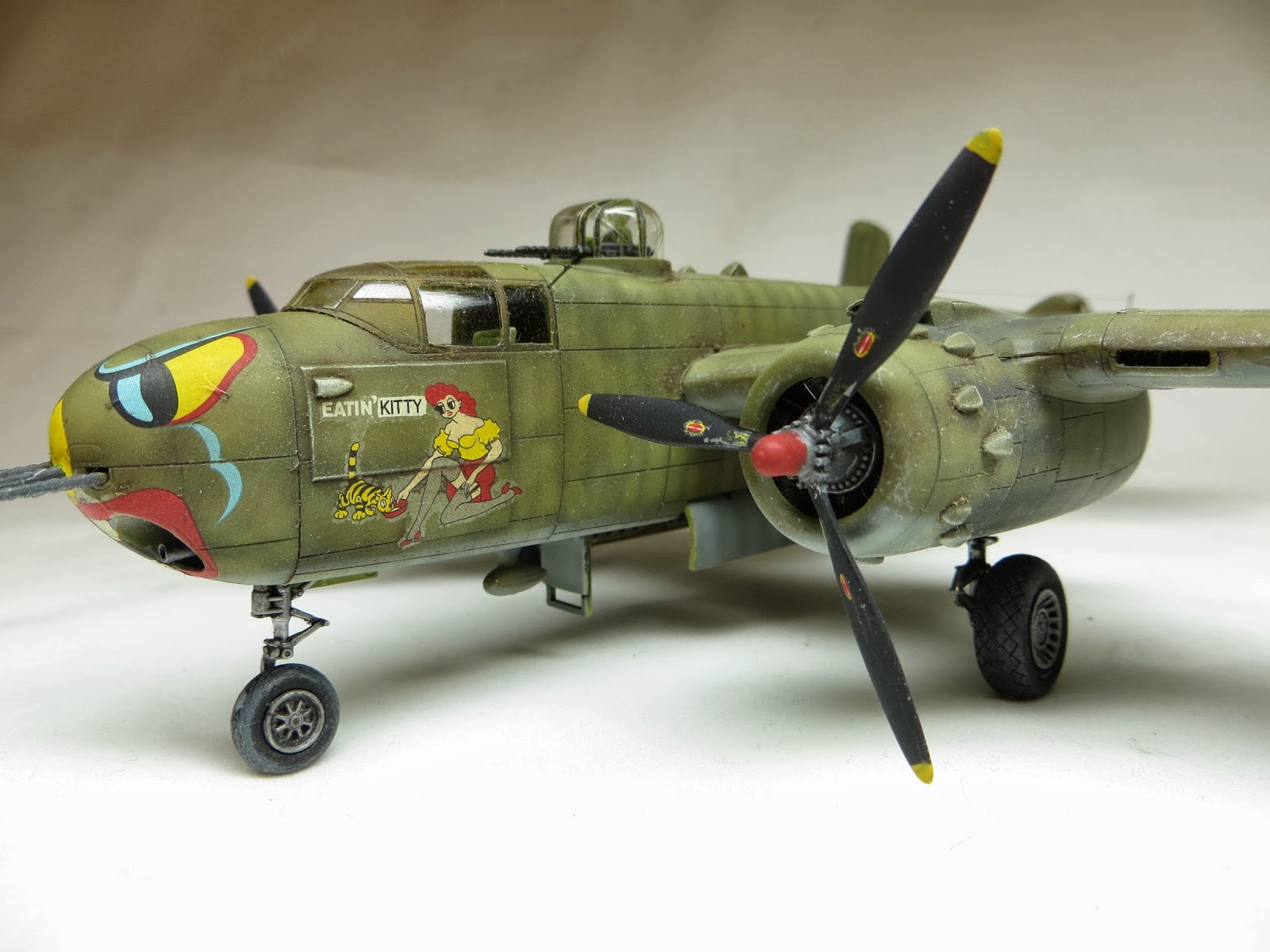
  • Other ongoing projects - the B-25 in 1/48. Yes, it's the well-travelled Monogram kit, but with Aeromaster decals. Always fun.


  • The Fletcher Class Destroyer in its masked-up guise.


  • Kits coming up for build - the AMT/Revell A20J, and the Tamiya P-51D with an Aires detail set. More on these later.
So, as you can see, not a moment to spare for idle blogging. Ooh, and I just bought the Apollo Command/Service Module - that's going to take me down a different sort of path. Interested? More later.

Saturday, 20 June 2009

Setting the Scene


Just opening the box and sticking the parts together is something you do when you are eleven and have just returned from the shops, having blown your pocket money at the nearest model emporium.

Forty years (+) later, and things have changed a bit. I still return from the shops - although these days I'm more likely to be carrying a 6-pack of dog food, toilet roll, cornflakes and a packet of aspirin. The model emporium is almost no more, so my box will have winged its way to my door via the internet, but the feeling when I take the lid off remains the same, that excitement that accompanies the first riffle through the contents.

Before the side cutters can come out, though, there's more work to be done. Reference photos must be examined and compared. Information must be gathered. Books must be pored over, and the internet trawled. Researching your project is always a good part of the job, always fascinating.

For me, a significant part of this is the men and their exploits. Reading up on historical background gives you an intimacy, a familiarity that gives your imagination free reign when the build is in progress. Here are some photos of my latest project, the Fletcher Class Destroyer in 1/144 scale. As you can imagine, it's a big build. Before I could start it, I spent considerable time on pure research. The kit offers two vessels - the USS Fletcher, and the USS Chevalier. During my research, however, I came across the USS Nicholas D.D. 449, a Fletcher Class destroyer of the same period. It has an impressive war record, ending at the signing of the Declaration of Surrender in Tokyo Bay in 1945. After careful study, I think it will make an excellent alternative to the box options.


I'll return to this project over the next few months, with more photos of this lovely build.

Saturday, 13 June 2009

The Classic 'Wind

When I am commissioned to build a new model, the subject may not always be a favourite with me, but by the end of the work I have almost always bonded with it. The least likely kit can become a favourite when you are building it from cold, and it's an experience that widens my own interests.

Sometimes though, I am asked to build a kit that's already an all-time favourite. For years I've been asking why no-one had produced a Westland Whirlwind in 1/48? And then someone did, and I've been trying to get to it ever since. When I was asked by a client to build one, I was a happy man.

The kit duly arrived, and I spent a couple of days just poking though the bits, sorting and savouring what was to come. It's a typical Classic Airframes kit; low pressure injection moulded plastic, with the cockpit in cast resin and a small photo-etched fret containing the minor parts. I was pleased to see that the main parts of the landing gear were in white metal, and well moulded too.

Knowing Classic Airframes as I do, I knew it would be better to make up the fuselage so that the cockpit has a proper mounting place, especially as there is a radio tray, radios and canopy fairings to fit, as well as the cockpit itself. That resin cockpit is superb, by the way!

Adding the wings was made much easier by widening the slot between the upper wing sections.
Engine nacelles were next; I'd anticipated problems here but the fit was surprisingly good and needed only a little filler.

The 'flying' tail and vacform canopy were quite straightforward, and the canopy was done on the first attempt.

Paintwork came next - my favourite part. I started with a light undercoat, as I had chosen the early brown/green camo scheme. This helps when weathering, because it can quickly become too dark, even in this scale.

Pre-shading was next, underside only and then the alternate sky and black configuration, giving the aircraft a dramatic look. Then masking up for the upper camo; I don't like using tape for this, so it meant rolling out quantities of Blu Tac. If you use masking tape, you give the paint a 'shoulder' to lean on and always get unwanted paint build up. The Blu Tac gives a nice, semi-soft edge, and looks 'scale-right'. It's a long process when doing a whole model, but worth it. To weather the uppper camo, I used a combination of light browns and yellows. With the airbrush turned right down, these were the results.


Next up, the decals. The colour density was good and so was the register. They were easy to apply, but needed planty of moisture to get them into position. They needed all day to settle down, and regular coats of setting solution. By evening, the were down nice and tight.


After the next glossy barrier came a dark wash. A dark brown was quite suitable, and it blended well with the early war camo. After matting this lot down, it needed a couple of days to dry, so I allowed myself to be distracted by...er, well that's for next time.

One of Classic's traits is the often ponderous fit of the parts. The Whirlwind had gone pretty well so far, but now came the landing gear. The white metal parts look great, need only minor cleaning and each assembly went together ok. Fitting them in the engine nacelles, though, was another matter. Was it because the engine nacelles are too small, or the gear too big?


I ended up cutting slots out of each gear leg to allow them to reach the engine bulkhead. This worked very well, but needed extreme care. Lastly, the resin cannon barrels; these are nicely moulded but need little chamfers cutting in to their bases so that they'll attach properly to the nose.

I was free now to fit the remainder of the parts: gear door, aerial(I used stretch sprue for this) and so on. All routine stuff. So, can I now sit back and enjoy the fruits of my labours? I think so, but not for too long, because the washing up won't wait forever.

The aircraft itself did not enjoy a long, meritous career with the RAF - it served with only two squadrons, and a scant one hundred and fourteen examples were produced. The type was phased out in 1943. A sad end for such an elegant and imaginative design.

Wednesday, 27 May 2009

More Bang for your Bucc

When last I posted on this project, I was getting through a very difficult phase of its construction. A lot of filler and rubbing down later, and the build was beginning to come together. To illustrate this, here are some photos of it at this complex stage.


Part of the brief was a nice selection of Airwaves photo-etched parts, and a pair of Heritage resin jet intakes. These additional parts have made an important difference to the final finish, I feel.

Royal Navy aircraft are always kept in pretty clean condition so I was loathe to add too much weathering. I opted for a paint discolouration, to take away from that die-cast metal model look.

At first sight, the Airfix decals closely resemble postage stamps. They turned out to be a little tricky to fit because they are so thin - which came as some surprise! But, treated properly they went down without problem and pick up the surface detail remarkably well. Over the decals went a round of varnishes and washes and then I applied the last coat, a satin varnish.


Adding the folding wings was more straightforward than I thought. The photo etched wing folds were an excellent fit - though it would help to have three hands....


It's not a flawless kit - the fuselage is very tough to bring together, some parts are overly thick, and the decals were a challenge - but it was unexpectedly rewarding on the whole. I'd do it again just for that reason.


Size isn't everything?


The trend for miniaturisation does not seem to extend into modelling. I have a soft spot for the larger model - the large the better at times - so you won't find too many teeny tiny kits in my modelling room.

New houses are similarly miniaturised, but ours was built in the 1800's and so the room I use to work in is spacious and high-ceilinged. This gives me room to stack kits as high as I can reach - useful when two of them are a 2'6" PT boat and a 4' Gato sub, and I'm just about to add a 2'6" destroyer!

It's all very well manufacturers tempting us with these bigger kits, but where are people to display them? I've just seen the test shots for Trumpeter's new 1/32 scale Swordfish. It's beautiful, but very large and quite delicate. In a 'modern' semi, the only spare space might be in the loft.

Where do you display your large scale models?

Saturday, 16 May 2009

Just when you thought it was safe....

In an earlier posting, you may have seen me blathering on about the rewards of building an older kit, the silk purse and the sow's ear etc. Well, I may have met my match here.

I recently took on a custom build in the form of the Airfix Buccaneer in 1/48 scale. It was one of their earlier releases in this scale that was to save the company from going under back in the nineties. I believe the original tooling was by Occidental of Spain. They were notable for a Texan/Harvard and a Spitfire Mk.IX, in pink plastic! A nice novelty. Anyway, the Airfix-Occidental union went on to spawn the Buccaneer and history was made.

The fuselage parts with integral engines fairings are a horizontal split, which is a good thing, but not easy to get together. After some pushing, shoving, shaving, bending and cursing, it was done. And this is just the beginning! Rinse, lather, repeat with the jet intakes, the exhausts, the cockpit tub and the tail fin.


And this is where I am up to. The photos log the travails all modellers will recognise. I'm getting there and it's going to be a lovely model, but it's a slow process. More on this project as it comes together. There's only one winner - I just hope it will be me!